General

Another One Bites the Dust … Sad or So What?

A very good photographer I know recently told me he is phasing out of making traditional silver gelatin prints in the darkroom in favor of those he can make using an ink jet printer.  He will still use film, but have his negatives scanned into digital files that in turn can be easily and quickly produced. He told me that with the current state of software technology, he could no longer tell the difference between a digital black and white print created with a hybrid process and the real thing.

So I spoke to a number of other equally fine black and white photographers in the know about this and they respectfully disagreed.

The question for me is whether I should feel bad about this, or simply not care?

Well, after some thought, I’ve decided I do feel sad and I simply don’t care! Why? First of all, I think you can tell the difference between a finely executed black and white silver gelatin print and an inkjet print. Others I respect feel the same way.  And don’t even think about a comparison between black and white contact prints made with platinum, albumen, carbon transfer, or tintypes, etc.  So I feel sad that someone who has worked for years to create an important body of top-notch black and white analog work will no longer be creating such work.  It’s a loss in my opinion and I’m disappointed.

On the other hand, so what!  There are plenty of those who understand the beauty of a purely analog black and white print and the work that it takes to make one.  And there are plenty of those, especially young people that are embracing analog as proper alternative to digital.  It’s not just the way the final image looks … yes that’s important … it’s everything that goes into making it a reality.   So if you want to do it the easy way, knock yourself out.  That’s your decision, but don’t tell me it’s the best way for black and white. Not for your personal work, or work you wish to exhibit.  I’ll give you a pass for commercial and color work.

Personally, I’m more interested in focusing on the work of those that want to make the effort, rather than doing it the easy way, or the way that emulates the look of a silver gelatin image made with a Tri-X negative, or the way that almost looks as good as a print produced in the darkroom.

This past week my friend and I finally finished the framing in on my basement project and this week we’re on to the drywall. They say that when you are finally putting up drywall you’re nearing the finish line. I hope so! Whenever we could use a screw to attach two by fours or two by sixes we did, and the drywall will be screwed into place as well.  When the project is done, no one will be able to tell whether I used screws or nails, but I’ll know.  I’ll know that it took longer, but it was built stronger and finished better.  I’ll also know that it was also built with pride, because I will feel it inside. Finally, I’ll know that it will stand the test of time, the walls won’t bow and I’ll never see a nail pop!

It’s the same way with making a print. I’m happy to do it the hard way, the better way, with pride in my craft. Maybe some won’t know the difference or claim they won’t, or care, but I will.

Stay safe,

Michael

Democracy is Worth Fighting For!

It’s 12:15 on Sunday night and I’ve needed to write something different.  Please forgive me for any grammar mistakes.

I generally try to stay away from politics, but regular visitors to this site know that I have touched upon issues threatening our democracy during our recent darkest hours.  Now Ukraine, a sovereign democratic nation, still in its infancy, is fighting for it survival against Russia and its autocratic dictator Vladimir Putin. None of this should be a surprise. What else should not be a surprise is that Putin has received the support of his sycophant and autocrat wannabe Donald Trump, along with a number of what used to be the Republican Party.  Sad and pathetic!

It’s hard to write about photography, something so dear to my heart, when a proud democratic nation is fighting for its life while Trump and those that kiss his ring are heaping praise upon a ruthless fascist thug.  Of course, these are the same people that have been and continue to work to undermine the democracy of our own nation.

I shutter to think what the current situation would be here in the United States and in Europe had Joe Biden not won the 2020 election. But even with his victory the dark forces that would take away our democratic freedoms are still hard at work at home, while the individual many of them admire so much is directing the Russian march across Ukraine.

What Putin didn’t count on was the resolve of Ukraine’s people not to give up and the decision of America and its allies to stand together. Now that the world has seen Putin’s atrocities, those in the US that supported him and his actions should be judged accordingly.

My prayers and best wishes are with brave people of Ukraine, and those that are working to save our own democracy.

I look forward to discussing photography again next time.

Stay safe,

Michael

More on Not Wasting Your Precious Time … Meaningful or Not?

Periodically I take a look at several photography sites I have bookmarked to see if there’s anything new of interest. The ones I like the most are those that include written entries along with photographs (usually black and white). One I like very much is Leicaphilia, which can be found at http://leicaphilia.com.

Here’s a quote from an entry that appeared on April 7, 2021, entitled Significant Fact…or Insignificant Flicker?

“Having had looked at lots of it over the years, I’ve concluded there are three types of ‘Street Photography’: 1) photos of people on the street (go to any popular photo forum – and a lot of street specific websites – and you’ll see endless variations of this); 2) gimmicky photos of people in public spaces e.g. people caught in awkward poses or fallen in the street etc.; or 3) photos that attempt to say something about a person in the street, or something about the person’s relationship with someone else in the street, or something about the person’s relationship with the built environment. (It helps as well if it also has a pleasing or interesting aesthetic i.e. it’s not completely dependent on its subject matter to generate interest). It’s only this latter type that holds any real interest…for me.”

I do a lot of candid myself and I love the work of Elliot Erwitt, Henri Cartier-Bresson, Vivian Myer and many, many others that have worked in the genre. I also see a lot of it by others, especially on the Internet, so when I read this I really identified with the message!

Let’s face it; there’s a lot of junk that’s put out, especially related to street.  Aim and shoot … or don’t even aim and shoot. Use a wide enough lens and fire away from the hip … literally!  These images simply will not stand the test of time (a very short time to sure!), let alone have any value other than being visual records of people that happened to be on particular streets at particular moments in time.

But why focus only on street?  There’s plenty of other junk out there to be seen containing dubious subject matter of questionable taste or just boring stuff. Perhaps the lamest pictures are the technically perfect snoozers. All of this can be viewed at galleries in supersize, which I believe is a means to somehow mask mediocrity. I know I have made that point before … sorry … but it remains the truth … at least for me!

So three things are of critical importance, especially with respect to your precious time: (1) don’t waste it looking at this stuff; (2) don’t waste it by creating it yourself; and (3) give your best shot (no pun intended) to your keepers in the darkroom, so you don’t have to print them over again!

Oh, and something else. Study the true masters. Go see their work whenever possible and buy books containing their images.  Then, when you grasp the essence of their vision and what makes their images so special, apply the lessons learned to your work.

Stay safe,

Michael

Don’t Waste a Moment of Your Precious Time!

Photo by Mel Evans

I’ve written before about how important the “journey” part of photography is for me. Sometimes if I’m lucky it leads to important friendships.

Along they way I met Drew Wagner. Drew was a fine photographer and a founding member of the Monalog Collective. His work was completely different then mine but we became friends and colleagues in support of black and white analog photography.

I last saw Drew in December and we spoke several times in early January. Then all of a sudden and out of nowhere he got sick and passed away this past week … just one month after he was diagnosed.

Drew was a great person and a fine photographer.  He said that he was captivated by the magic of the optics, mechanics, and chemistry of photography since he held his Aunt’s twin-lens reflex camera as a teenager. This led to a lifelong passion with photography, and black and white analog photography in particular. He worked with medium and large format cameras and developed silver gelatin and dry glass plate negatives to create silver gelatin enlargements, silver chloride contact prints, and albumen contact prints in his darkroom.

Look, we’re all going to die. It’s part of life, but often death comes too soon, as was the case with Drew.  He had so much he wanted to do … new projects, working with Monalog to establish a student mentor program and more.

Drew was excited about learning and experimenting with alternative processes and making wonderful photographs until it was all taken away. He had a passion and pursued it! In the end he was gone before his time and all the new ideas and projects he had planned but a dream.

Drew did the hard work and had a clear vision of what could be done next.  His life was filled with meaning and purpose.

What about you?

If you have a passion for your art, or anything in life, don’t waste a moment of your precious time. It all goes by fast.

Hey Drew, keep on shooting!

Stay safe,

Michael

My Favorite Top 10 Black and White Analog Photographers – #4 Edward Weston

The Top 4, The Final 4!  That’s right baby, we are down to the final four of my My Favorite Top 10 Black and White Analog Photographers!!

Landscapes and seascapes, nudes, portraits, peppers and other vegetables, sea shells, everyday objects, and yes, even toilet bowls – Excusado, 1925 – and more! A founder, of the famous Group f/64 along with Ansel Adams, Imogen Cunningham, John Paul Edwards, Preston Holder, Consuelo Kanaga, Alma Lavenson, Sonya Noskowiak, Henry Swift, Willard Van Dyke and Brett Weston. Author of the seminal Day Books. Here Weston wrote about Excusado … “For long I have considered photographing this useful and elegant accessory to modern hygienic life, but not until I actually contemplated its image on my ground glass did I realize the possibilities before me. . . . Here was every sensuous curve of the “human form divine” but minus imperfections.”

A true master and a genius!

Weston created countless beautiful and meaningful photographs, with the simplest of equipment and no enlargers – all contact prints made using a bare bulb!  For this alone he should be an inspiration to all of us, especially to those who obsess over owning the latest camera(s), the latest and most expensive lenses and the question of which format to use.

Hey, I once drove almost a 400 mile round trip to see an outstanding exhibit of Weston’s work at the Michener Museum before I moved to Doylestown. I’m certain that experience that must have had an impact upon my decision to move here!

I feel very lucky to own many of his wonderful monographs and a first edition of the Daybooks. For those that don’t I suggest you add them to your library and study them often.

Stay safe,

Michael

Don’t Take It For Granted!

Don’t it always seem to go
That you don’t know what you got ’til it’s gone – Joni Mitchell

Just got back in from shoveling and snow blowing outside to write this.  The Nor’easter wind was blowing the damn snow into my face while I was trying to remove it from my driveway, so I started thinking about something more pleasant … my photography!

But then, as a fresh gust blanked me, I remembered that I’ve been without access to my darkroom now for over a month or so because of my basement-finishing project.  Not only has my darkroom been turned into a storage space, it is all but barricaded $#@%^&*!  And before that it was in a discombobulated state, due to construction of extensions to my enlarging bench to accommodate the Leitz Focomat 1C and Leitz Focmat 2C that now reside next to my Devere 504.

And sitting on top of the baseboard of the Devere are about fifteen rolls of film that need to be developed @#!$$T%Y^!

As I’ve been pounding nails into countless two by fours or cutting wood with my friend on the table saw (I’m really just his glorified helper to be completely honest), I think more about my darkroom and the time I’ve lost for making photographs than the beautiful dedicated listening room I will have in the hopefully not to distant future.  And I’m sure I will be thinking about this even more while I am putting up all that drywall and painting!

I miss it all, but what if it was taken away for good? One of my friends around the corner just finished recovering from the Omicron variant. Fully vaccinated and boosted and still got the damn virus!  It wasn’t terrible except that he lost his hearing. Problem is that he’s a musician. We talked about it and what it could mean for him. Thankfully after seeing a specialist who proscribed something all is well and he can hear just fine!

That hit me awful hard. What if I lost my hearing? Then I couldn’t listen to my wonderful stereo and my vinyl collection of 4,000 or so records (I know, I know!) in my beautiful listening room I spent all this time and money building.  And what if I lost my vision … my mother had macular degeneration so I think about this from time to time … or couldn’t walk … I was in a nasty car accident about five years ago and still suffer from its outcome … what would happen to my photographic life I love so much?

Every time I begin to take things for granted I stop and think about just how lucky I am.  It’s a gift and I thank my lucky stars for it everyday. After all, it could all be completely different … a lot different.

Sometimes I wish I didn’t think about these things so much, but I’m glad I do, because you don’t know what you got ’til it’s gone!

Get out there, have fun, be creative and live the dream.

Stay safe,

Michael

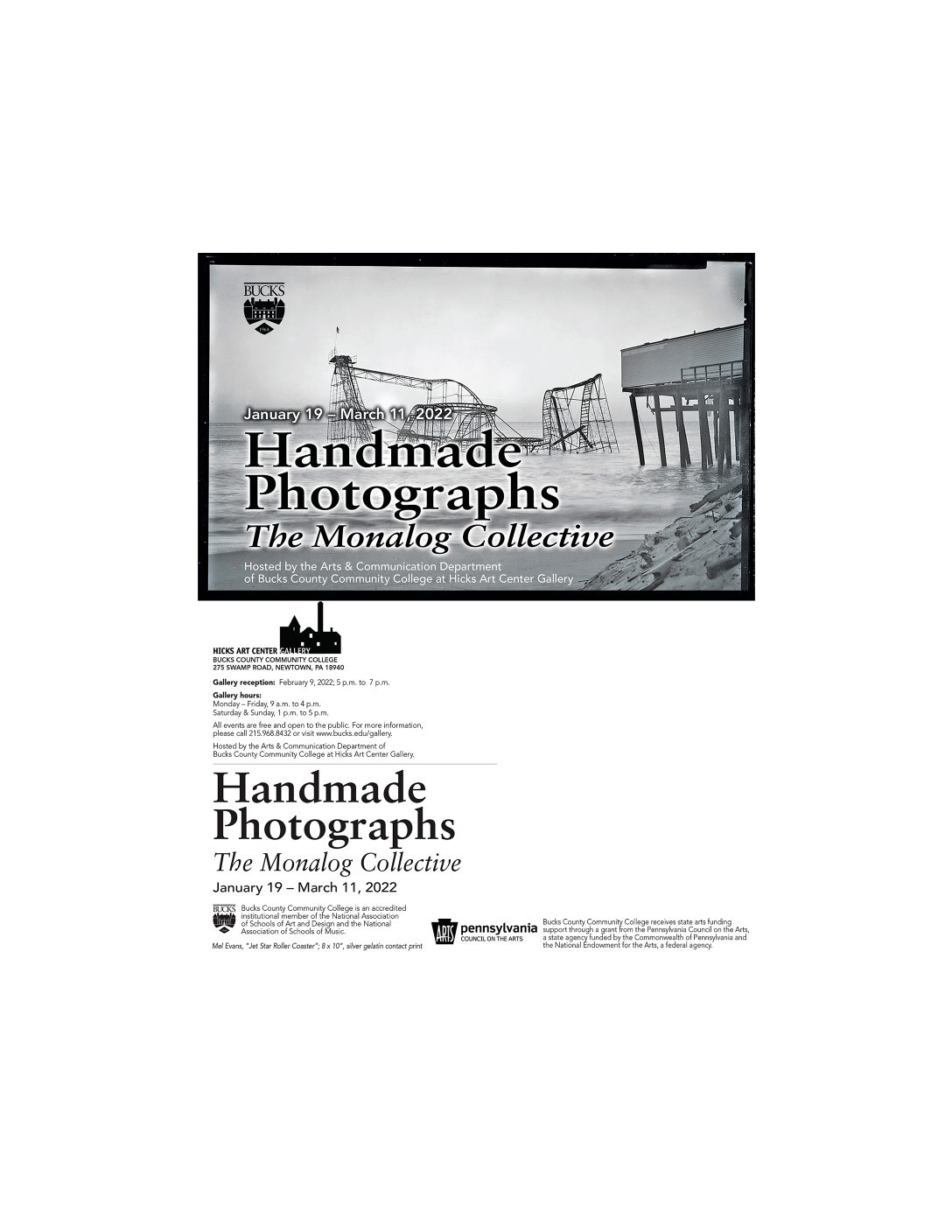
Monalog Collective Show at the Hicks Arts Center Gallery, Bucks County Community College, Newtown, PA, January 19th – March 11th

I am pleased to announce that the third stop of the Monalog Collective’s traveling roadshow is now at the Hicks Arts Center Gallery, Bucks County Community College, Newtown, Pennsylvania. The show is called Handmade Photographs: The Monalog Collective.  The BCCC has a well-known and storied photographic department, so I feel very honored to have this exhibit of our work. The Hicks Art Center Gallery is an absolutely wonderful space, and the college has done a beautiful job of putting the show together!

I hope you will join me on February 9th at 5pm for the show’s Opening!  The gallery is located on the BCCC campus at 275 Swamp Road, Newtown, NJ and is open Monday through Friday, 9am – 4pm and Saturday and Sunday, 1pm – 5pm.  For more immediate information visit www.bucks.edu/gallery or call (215) 968-8432.

Stay safe,

Michael

Make Your Pictures Stand On Their Own

Awhile back I stumbled across an interview of social documentary and street photographer John Free. The question posed was “On your website it says that you are a social documentary and street photography. Can you point out the difference but maybe also tell us more about the combination of these two genres as a photographer’s choice?”

Free responded, “I think that the three most important and also difficult forms or types of photography, is social documentary, photojournalism and fine art street photography, which was called straight photography when I started. I think that the difference between them is rather simple to understand. In photojournalism, six photographs with captions might be required. Social documentary photography requires 25-50 photos, which are each supported by a caption or short story. In street photography, it all must be done with one photograph and with no caption to help explain what cannot be seen. No caption and no posing, make street photography the most difficult form of photography that I have ever been involved with. My professional work in social documentary photography was very helpful in teaching myself how to get closer to the subject. Closer in many ways, not just where I stand, but how I can convey my feelings about a subject in my photograph of that subject. To bring as much life and understanding into the image, in order for the viewer to better understand the image.”

All interesting and I think very useful, but focused on this … “In street photography, it all must be done with one photograph and with no caption to help explain what cannot be seen. No caption and no posing, make street photography the most difficult form of photography that I have ever been involved with.”

I think it’s vitally important that our photographs be able to stand on their own as complete and self-contained personal statements.  All of your creativity and vision must become dedicated and focused to ensure that the picture you make faithfully reproduces what you initially saw in your mind’s eye … and felt in your heart.  But that’s only half the battle. What’s contained in the negative must be fully realized in the final print. Otherwise what had so much promise surely will end up as an also-ran.

When you make a photograph it should be a personal and intense experience. It doesn’t matter whether it’s made in Manhattan or Yosemite Valley. Same thing when you’re in the darkroom.

Easier said then done, right?  It is if you dedicate yourself to it!

It’s a new year. I’m going to try my best.

Stay safe,

Michael